


Anime Film Review: Mobile Suit Gundam Hathaway: The Sorcery of Nymph Circe
English Title: Mobile Suit Gundam Hathaway: The Sorcery of Nymph Circe
Japanese Title: 機動戦士ガンダム 閃光のハサウェイ キルケーの魔女 [lit. Mobile Suit Gundam: Hathaway’s Flash – Circe’s witch ]
Director(s): Murase Shukou
Screenwriter(s): Muto Yasuyuki
Studio: Sunrise
Released: 2026
Series Runtime: 1h 47m
Starring: Ono Kensho, Ueda Reina, Suwabe Junichi
This is the second part of a film trilogy based on the novel trilogy that was first published in 1989–1990. The novel trilogy was written by original creator Tomino Yoshiyuki.

This review assumes one has seen the first film. The plot is still set in 0105 UC—about twenty-six years after the One Year War in the original series (1979) and about twelve years after the Second Neo Zeon War in Mobile Suit Gundam: Char’s Counterattack (1988)—and continues more-or-less directly from the first film.
The plot is simple: Hathaway leads his team of Mafty forces towards Australia to deal with the Earth Federation as they plan to hold a conference there. Kenneth Sleg is handling security for the latter and this includes a disinformation campaign such as misleading communications and flights.
Meanwhile, anti-Federation forces that are not aligned with Mafty are suffering as well as causing trouble, and the mysterious Gigi Andalusia is still mysterious as she is perceptive. Her intuition and revelations contribute to a couple of Sleg’s decisions.

There is a mild sense of “cat and mouse” between Sleg and Hathaway but it could be more intense. On a related note, although the non-Mafty forces and Gigi play a substantial enough role, they could do more. It is arguably just enough, and complexity is nice, but there can only be so much in a feature-length film.
A little background is provided about Gigi but there is still too little about her, particularly her agenda (which she presumably has at least one). Given that this is supposed to be a trilogy, a little more should be hinted by the end of the second part at the latest.
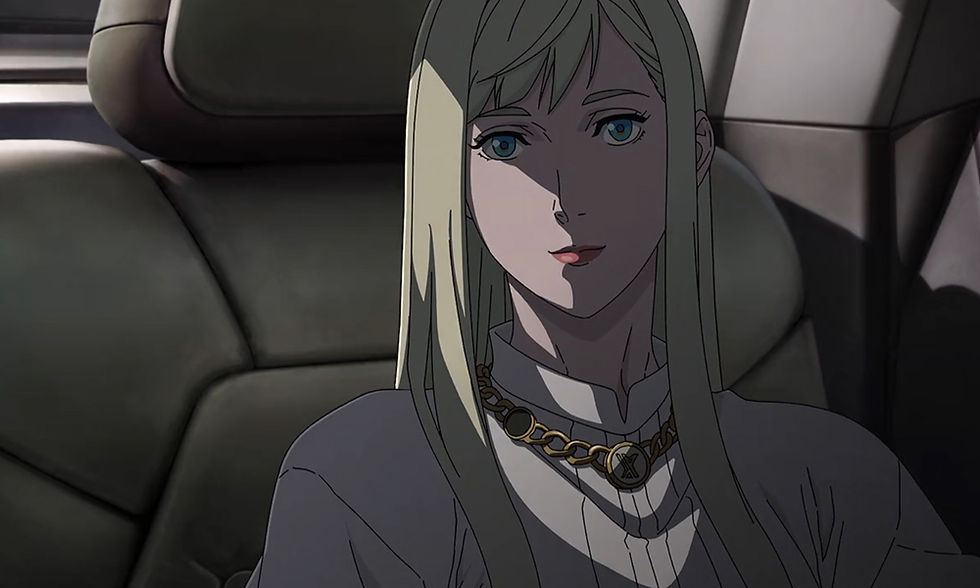

Visually, like the first film, it is generally excellent with its awesome detail and rendering. The occasional longer or tracking shots are cool. There are a few moments when the characters’ motion is a little awkward but that is a minor issue. The other complaint is that there are many nighttime or darker scenes that are a little too dark; it may be realistic but even just a little more accent on the highlights would improve clarity without taking away the realism and tone.
The mecha action is cool. Unlike many fight scenes in the franchise in which speed is emphasized over clarity, the action here is more organic. It is fast enough to convey the force and violence these machines are capable of, but slow enough to follow. Given the plot, it lacks the on-the-ground perspective of part one with a focus on aerial action.
The music by Sawano Hiroyuki is slick and arguably sounds more synth than orchestral. Either way, it mostly does not go for epic. The songs go for the spaced-out atmospheric feel with the use of chorus guitar, which is nice.
This is a decent sequel and worth seeing just for the visuals. This film and Demon Slayer: Infinity Castle I—the two are obviously of different styles—are probably two of the most polished anime produced so far. As for storytelling, it could use more complexity and more on the supporting characters, but it is simple and focused with steady pacing.
Be sure to subscribe to our mailing list so you get each new Opinyun that comes out!


Comments