


Films Review: Rurouni Kenshin The Final & The Beginning

English Title: Rurouni Kenshin: The Final
Japanese Title: るろうに剣心 最終章 The Final
Director(s): Otomo Keishi
Screenwriter(s): Otomo Keishi
Studio: Warner Bros. Japan, Amuse, Shueisha, KDDI, GYAO
Released: 2021
Runtime: 2h 18m
Starring: Satoh Takeru, Takei Emi, Mackenyu, Aoki Munetaka, Aoi Yu, Eguchi Yosuke, Arimura Kasumi

English Title: Rurouni Kenshin: The Beginning
Japanese Title: るろうに剣心 最終章 The Beginning
Director(s): Otomo Keishi
Screenwriter(s): Otomo Keishi
Studio: Warner Bros. Japan, Amuse, Shueisha, KDDI, GYAOReleased: 2021
Runtime: 2h 17m
Starring: Satoh Takeru, Arimura Kasumi
These films are a live-action adaptation of the manga of the same name written and illustrated by Watsuki Nobuhiro.
The Final was released in April 2021 and The Beginning was released less than two months later in June. As the titles suggest, these two films go together. Although they follow the original trilogy released between 2012 and 2014, it is another arc. I have not read the manga and the review is purely of these two films.
In The Final, a young man named Yukishiro Enishi (Mackenyu) of the Shanghai mafia returns to Japan. He is looking for Himura Kenshin (Satoh Takeru) and not hiding the fact that he wants revenge and it’s very personal.

As the plot progresses, it is revealed why via dialogue and a few flashbacks: Himura killed Enishi’s older sister, Tomoe. It was not a simple assassination, Tomoe was his wife.
Enishi, having vast resources and intent on making Himura suffer, causes a lot of trouble using his henchmen. Whilst the film is arguably a bit slow in the first half, there is, on balance, enough action throughout to break up the narrative.

As with the trilogy, the other major characters such as Kaoru and Megumi are still underutilized. Other supporting characters such as Makimachi Misao and Shinomori Aoshi make an appearance but not for long and lack substance. This film is an opportunity to act as an epilogue to the trilogy for these characters, so it is a lost opportunity. At least it is great to see Saito Hajime (Eguchi Yosuke) still constantly with a cigarette in his mouth.
The action is mostly impressive, especially Satoh Takeru. There is still the typical issue of some remaining idle in the background when there is a large number fighting, but that is to be expected. Visually, it is shot better, using longer and more stable shots that follow the action more clearly. The color saturation and tone are consistent to the spirit of the previous films.
Structurally, it is predictable and not dissimilar to the Kyoto Arc: antagonist causes trouble using henchmen, then eventually blows things up and/or sets things on fire, then escalates to the final duel. There is nothing wrong with that in itself, just don’t expect much else. That said, it at least avoids the silly “everyone turns up to fight the bad guy” in The Legend Ends.
The Beginning is a prequel set in 1864, some fifteen years before the “present” storyline. The plot follows Himura in those early days, focusing on his relationship with Yukishiro Tomoe.
The narrative quickly recounts Himura’s recruitment; as he is already skilled, it does not dwell on his training because he does not need it. This is good, no point having training slow the plot down.
Thankfully, it does not rush the relationship between the two main characters. It starts from the beginning when Himura defends Tomoe against a few guys harassing her one night. Later that same night, she witnesses Himura taking out a few others. He doesn’t eliminate her but keeps her close and she stays.
As usual, people are after Himura and to complicate matters, Tomoe is suspected to be a spy. She is the “cool chick” who does not smile and barely talks about her thoughts and feelings.
As before, Satoh Takeru’s performance is solid even though there are moments when he comes across as overdoing it a little. The standout performance is Arimura Kasumi as Tomoe. She plays the gentle and refined but cool lady initially. It is a little artificial but that is presumably the point, there is something awkward and not quite right about her.
However, that gradually changes and this transition is handled well in the writing and Arimura’s performance. It is precise but not unnatural.
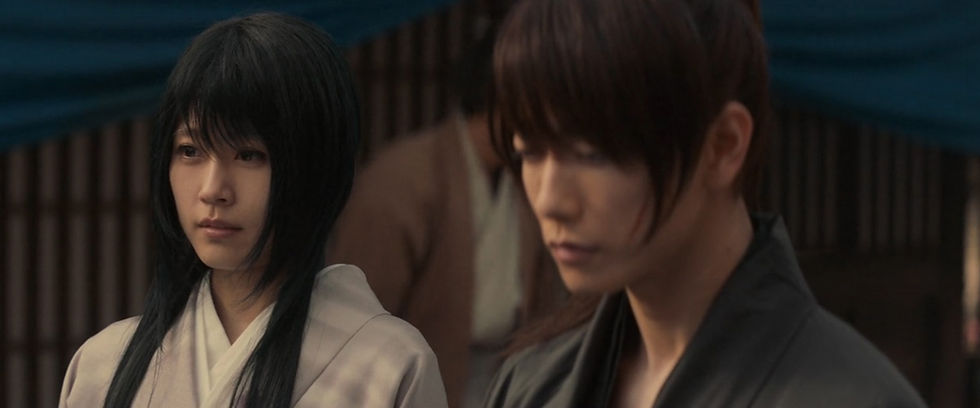
This prequel is meant to complement The Final and even connect a few elements shown in the trilogy. It reveals the background behind Himura’s decision to no longer kill.
There is nothing wrong with such a prequel but there are a few (potential) issues. Even though Satoh Takeru still looks young, he is noticeably older than in the first film released in 2012 so this is somewhat difficult to see past.
Also, it is natural to want to see a story progress. Finishing on a prequel film, even if it provides substantial background and ties up some loose ends, can still be dissatisfying. If it is a longer work, like a prequel trilogy, then that may mitigate that feeling.
So, can one view The Beginning first even though it is written to come second? It can be viewed that way, partly because The Final reveals a little too much information about the past anyway.
Overall, these two films can be tightened by maybe ten minutes but they are well-written and produced, and are enjoyable additions to the franchise.
Be sure to subscribe to our mailing list so you get each new Opinyun that comes out!


Comments