


Films Review: Rurouni Kenshin Trilogy
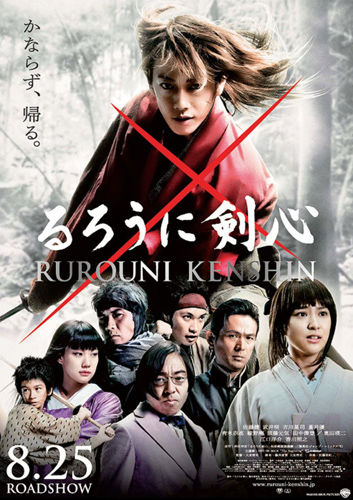
English Title: Rurouni Kenshin
Japanese Title: るろうに剣心
Released: 2012
Runtime: 2h 14m

English Title: Rurouni Kenshin: Kyoto Inferno
Japanese Title: るろうに剣心 京都大火編
Released: 2014
Runtime: 2h 18m

English Title: Rurouni Kenshin: The Legend Ends
Japanese Title: るろうに剣心 伝説の最期編
Released: 2014
Runtime: 2h 14m
Director(s): Otomo Keishi
Screenwriter(s): Fujii Kiyomi & Otomo Keishi
Studio: Warner Bros. Japan
Starring: Satoh Takeru, Takei Emi, Aoki Munetaka, Aoi Yu, Eguchi Yosuke
These films are a live-action adaptation of the manga of the same name written and illustrated by Watsuki Nobuhiro.
The films were initially a trilogy released in 2012 and 2014. Two more films were released in 2021. I have not read the manga so the review is purely of the films, and this brief review is of the trilogy only.
Set in 1878, about nine years after the Boshin War, the story follows the titular character, Himura Kenshin. He was a battosai, an assassin, and is now the “wandering swordsman trying to atone for his past”. He has also sworn to never kill again and wields a reverse-bladed katana, offering to protect the defenceless.
The first film, also known as Rurouni Kenshin Part I: Origins, is obviously an introduction to the character and the world. Himura Kenshin (Satoh Takeru) is a quiet young man who keeps to himself and is softly spoken when he does open his mouth.

Arriving in Tokyo, he defends Kamiya Kaoru (Takei Emi) and her kendo dojo. She is going through a difficult time because some former battosai, supposedly linked to her school, is suspected of murder. At the same time, Kenshin himself is a suspect given that he is a swordsman.

Not surprisingly, organized crime is involved. One of the villains is Takeda Kanryu (Kagawa Teruyuki), who produces opium. He is not a villain with combat skills but rather the cruel businessman who is supposed to be more intellectual (not that he is that smart). His henchmen, however, are skilled in fighting and they are the ones Kenshin has to deal with. There is, of course, one swordsman in particular who is a match for Kenshin.
Meanwhile, Takani Megumi (Aoi Yu), a physician making drugs for Takeda escapes that life and meets Kenshin and Kaoru. So, here is another motivation for Kenshin to take out Takeda.


Kenshin also befriends Sagara Sanosuke (Aoki Munetaka). It’s the stereotypical “two heroes becoming friends after they meet and fight”. The latter is skilled so he is not exactly a foil character but he is an opposite in terms of character and personality; he lets his feelings drive him, and is more outspoken and overtly aggressive. Whilst coming across as a villain, he is morally grey in the sense that he has no intention of being bad beyond trying to look cool but he is not trying to be a hero either.
On balance, the cast mostly looks like their characters and they do a solid job. Satoh does well as the calm and quiet hero. There are moments in which his annoyed and/or angry look is overdone and tacky—his relatively handsome looks demand a subtler approach—but he mostly looks the part.
One of the main weaknesses is that the main characters like Kaoru and Megumi are not significant enough. It is admittedly difficult in a feature-length film but at over two hours, this could be accommodated. Unfortunately, this problem gets worse rather than better for the rest of the trilogy.
The next two films, Kyoto Inferno and The Legend Ends, as the title states, cover the Kyoto arc in which former assassin/soldier, Shishio Makoto (Fujiwara Tatsuya), intends to wreak havoc and take over the current government. Basically, he is another “dude who should be dead but comes back to life and sorta has more powers”.
So, Kenshin is tasked to take out Shishio. As a potential minor spoiler but it is predictable, Kyoto Inferno is a little like The Empire Strikes Back in which Kenshin is in a tough spot by the end; it does not end in a cliffhanger but it is a “to be continued” moment.
The Legend Ends starts with Kenshin visiting his master and trying to learn what he needs to defeat Shishio. In short, it is a variation of the “take the hero out of his suit” premise, something which The Dark Knight Rises (2012) and Iron Man 3 (2013) adopt, just to name two contemporary examples.
Visually, it looks good. There is good use of color saturation but obviously not to the extent of K-dramas. It at times goes for the warmer and dryer tones to convey the sense of a jidaigeki (period drama) set in late-1800s Japan with dirt roads.
The action sequences are generally excellent, the swordfighting having a good blend of the fantasy and half-realistic approach. In some shots, it is questionable whether it is Satoh but when it is him, his speed is impressive. No doubt his martial arts background helps.
The film editing avoids the quick, kinetic cutting as the camerawork is more conventional in the sense that it tries to stay with the action. The film editing is still seamless but the camerawork can be more stable to better follow the action and provide more clarity. This fortunately does settle and improves in Part II and Part III.
The music composed by Sato Naoki has a mix of rock elements and traditional orchestral themes. The soundtrack is definitely noticeable but the genre justifies that approach. There are moments in which the riffs/themes push the boundaries into tacky territory but it mostly fits.
Live-action adaptations of manga and comics can easily suck, and often do, so this trilogy is perhaps a pleasant surprise. The main characters Kaoru and Megumi are underutilized and all three films can be tightened by five to ten minutes. It mostly looks good—it is colorful enough without being too “comic book” but also not pretentiously gritty, thereby ignoring its manga origins.
There is plenty of action and the structure is typical in the sense that the plot progression sets up these action set pieces in a measured way. The climactic fight in Part III is way too convenient in which everyone that matters just turns up to clash with Shishio or his followers.
Whatever weaknesses the work has, it mostly looks good and the cast mostly sells it so the three films are still enjoyable.

Be sure to subscribe to our mailing list so you get each new Opinyun that comes out!


Comments