


Anime Review: Sparks of Tomorrow
English Title: Sparks of Tomorrow
Japanese Title: 二十世紀電氣目録 [lit. 20th-century electricity catalog]
Director(s): Ota Minoru
Screenwriter(s): Urahata Tatsuhiko
Studio: Kyoto Animation
Released: 2026
Runtime: 13 episodes, ~23m each.
Starring: Uchida Yuuma, Amamiya Sora, Uchiyama Koki, Takeuchi Shunsuke, Kotobuki Minako

Based on the light novel by Yuki Hiro that was first published in 2018, the story is set in an alternate early 20th-century Kyoto, Japan, in which gas and steam power are the norm. I have not read the source material so this review is of the anime only.
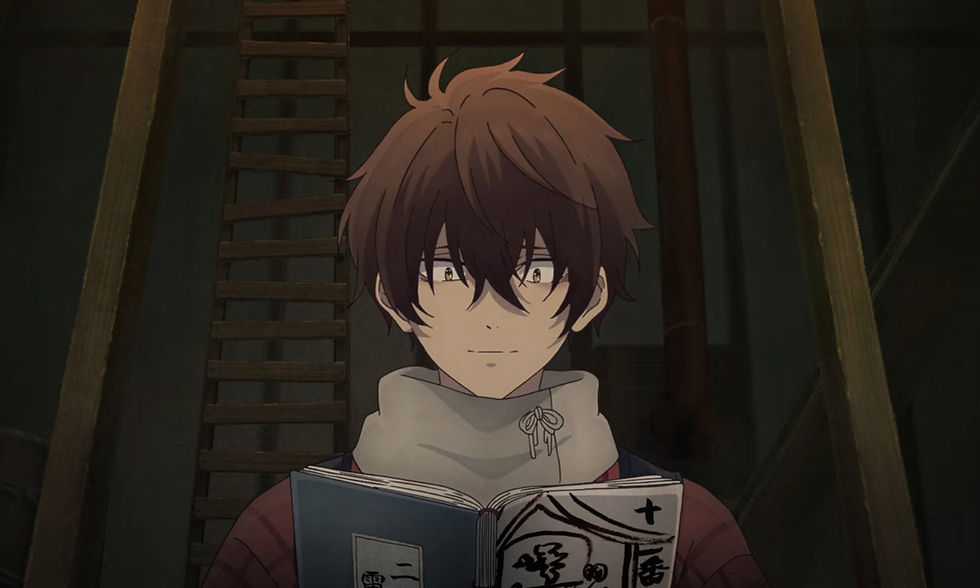
Sakamoto Kihachi is a teenage boy who works as a repairer. His older brother, Seiroku, had a passion for electricity and dreamed of ushering in the age of electricity. Together, they wrote the “catalog” that contained their ideas of electrical machines and applications. However, Seiroku went off to war along with the catalog and never returned.
Meanwhile, Momokawa Inako is tasked by her older sister, Noriko, to return the catalog to Kihachi. The Momokawa family is a sake brewer and Inako is arranged to marry Mizoe Yosuke, the heir of a powerful steam company. He is the villain of the story and is after the catalog.
The premise is interesting but two of the main characters are annoying. The three main characters are obviously meant to be very different as part of the conflict, but it pushes this too hard.
Kihachi jumps in fright at the smallest thing and Yosuke is a pervert who is so up himself and entitled that it is difficult to empathize with him. Even for anime, it is forced and pushes it too far.
Inako is relatively normal; she can be clumsy but she is a pious and good-natured person. Like Kihachi, she has a timid side, unable to stand up to her father against the engagement. But this is realistic and much more understandable.
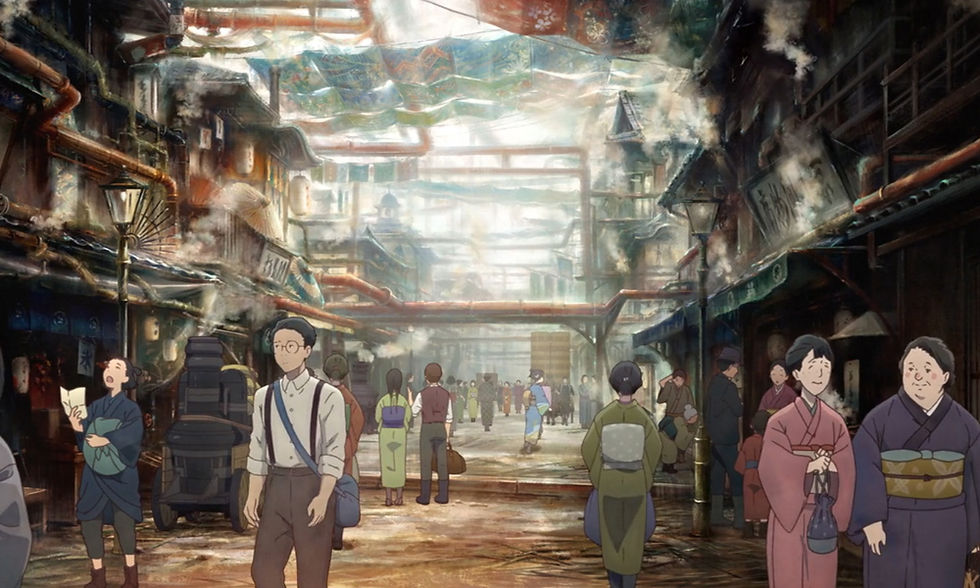
Whilst pollution from steam is constantly conveyed visually, this is thankfully not dwelled on through dialogue. Nonetheless, the idea of going electric is a bit suss nowadays even if it is not constantly in your face.
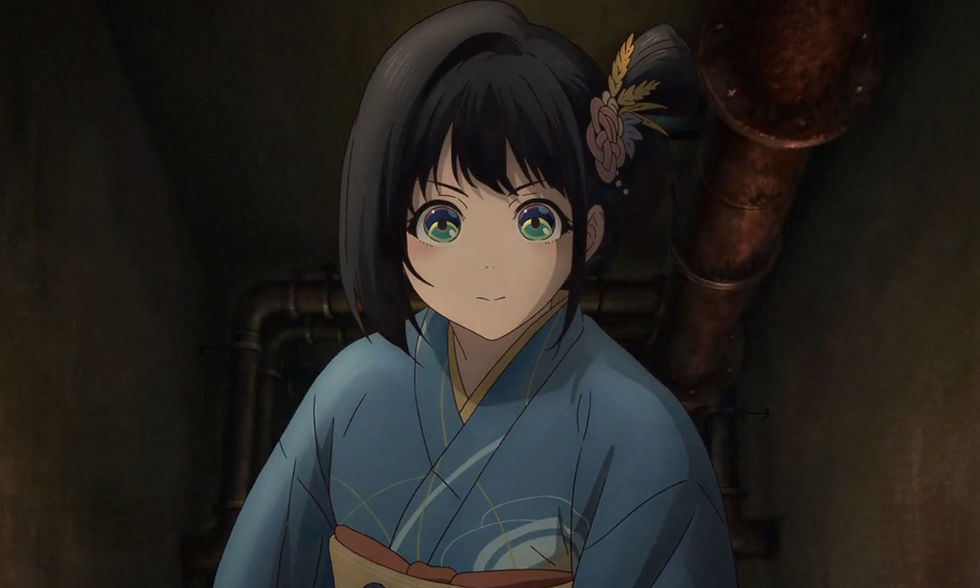
One of the central themes is about chasing and defending one’s dreams. Kihachi has to do this without his older brother and Inako has to decide whether to go along with the marriage or sticking her own aspirations. As expected, Kihachi and Inako encourage each other, although it resorts to Inako being the savior a little too much.
A natural extension to that is obsession. Chasing dreams is one thing but doing so without regard to others is another, and Yosuke is the character that blatant displays that.
Visually, the style overtly goes for the arty and is done nicely with the pastel colors and rougher conte-like texturing. The only major issue is that it goes for the exaggerated goofy faces in certain moments when it is unnecessary and not that fitting to the genre. There may be comical moments but that is not the tone of the work. It is at least moderately dark so it should try to be consistent to that.
The score composed by Koto Hitomi has a lot of softer woodwind and brass themes typical for stories that have a bit of mystery or just “cute, amusing and intriguing” moments.
The plot is partly like a mystery. The catalog has unclear or hidden information, and the interested parties have to figuratively or literally decipher the material. The series is initially a little episodic as Kihachi works on inventions but this does not ruin the show.
Whilst the tension from the mystery is effective enough, the threat and conflict from Yosuke are too forced for the sake of drama. It is not merely that he is annoying but also that Kihachi is conveniently not prudent enough. He is not supposed to be stupid but somehow he fails to make copies and hide the catalog knowing Yosuke desperately wants it. Even if no one like Yosuke is around, one would still take precautions.
Ultimately, it looks great but two of the main characters are annoying and the plot lacks substance. There is some mystery and intrigue, more background does get revealed and more characters are brought in; these aspects are handled well enough. However, on balance, the primary goal and conflict regarding the catalog wanders a bit. This may work in a novel but not necessarily as anime.
Be sure to subscribe to our mailing list so you get each new Opinyun that comes out!


Comments