


Anime Review: Macross 7
English Title: Macross 7
Japanese Title: マクロス7
Director(s): Amino Tetsurou
Screenwriter(s): Tomita Sukehiro
Studio: Ashi Productions
Released: 1994–1995
Series Runtime: 49 episodes, ~25m each.
Starring: Canna Nobutoshi, Sakurai Tomo, Sugawara Masashi, Takano Urara, Koyasu Takehito, Hayami Show, Takeda Eri

It has been over 30 years since the release of Macross 7 and any fan of the franchise would have seen it already, but perhaps it is worth revisiting if only so I can review this before proceeding to the next series.
The release of Macross 7 closely follows Macross Plus (1994–1995), a tight four-part OVA. So, Macross 7 is the second sequel to Macross (1982–1983) but the first that is a lengthy series. This generated some excitement at the time, especially given the quality of Macross Plus.
To those who love Macross and Macross Plus for their mature storytelling, the plot and tone being somewhat dark and bittersweet but not too dark nor outright tragic, then Macross 7 is jarring and possibly disappointing.
Premise and Setting
Set in 2045, five years after Macross Plus, the plot follows the fleet that departed Earth in 2038. As the name indicates, it is the seventh ship of the newer Macross-class city ship.
The main character is Nekki Basara, a resident of Macross 7 and lead vocalist and guitarist of Fire Bomber. The keyboardist is Ray Lovelock, who is ex-mil, and the drummer is Veffidas Feaze, a large Zentraedi woman who says little.

The female lead character is 14-year-old Mylene Jenius, the youngest daughter of Maximilian and Milia Jenius. She is the band’s newly recruited vocalist and bass guitarist. Like Macross Plus, the triangle template is two male and one female instead of the one male and two female in the original series. The other male lead is Gamlin Kizaki, a pilot of the elite Diamond Force comprised of three VF-17s.

When the fleet is attacked, Basara flies out in a modified VF-19 and sings. (How he got the latest fighter is revealed later.) Although singing during battle is normal in Macross, the main character doing so in a fighter in the midst of it is another matter. He takes a pacifist approach of not firing any weapons and only dodging enemy fire.
The plot follows how the fleet and Fire Bomber deal with this enemy.

The Annoying Main Character
Although Basara does not actively stop friendly forces from firing, he doesn’t care about getting in their way either, no doubt causing lives to be lost whilst expecting people to listen to him sing. He annoys the likes of Gamlin and at least some viewers.
What makes it worse is that the songs are tacky arena rock with mildly glam rock/power metal vocals. At least it is a little comical, which is presumably intended. But it’s still annoying, especially when for too many episodes it is always the same song.
And that is pretty much the main character: he is annoying. A hero typically has some stubbornness but this guy takes it to the extreme. When asked why he flies into battle and gets in everyone’s way just to sing, he does not answer or gives a dismissive answer along the lines of “I just feel like it” or “You won’t understand”. But he expects people to listen to his music. Right.
Although he is not a stereotypical hippie and he mostly does not stop someone from fighting, he does think that only his approach is right. In other words, he is, to put it nicely, a snob and a jerk.
Other Characters & Relationships
There is some mild satisfaction when Mylene goes off at Basara. Being the daughter of Max and Milia, she has a good work ethic. However, it’s not as if she beats him up and, either way, that would not make up for how annoying Basara is.
The love triangle is not particularly strong but it is obvious that it is not meant to be. The focus is on Gamlin being interested in Mylene but she has a certain attachment to Basara since they are bandmates. Although this is natural enough, it feels a bit forced at times for the sake of drama.
In this regard, the series is not emotionally charged. Although that is not a bad thing in itself, neither her friendship with Gamlin or Basara really resonates either.
Max is the captain of Macross 7—strictly speaking, he should be called admiral since he has overall command of the fleet—whilst Milia is the mayor of the city. Setting aside the question of whether that should be allowed, it is good to see Max and Milia. Their relationship has somewhat deteriorated but the history is not elaborated on, so their situation feels a little convenient for the sake of drama. Still, they feature enough so that it is not merely fan service.
There are a great number of minor characters but, unfortunately, they are not well-utilized despite the length of the series. They don’t do that much to help drive the plot nor do they develop as people.
Setting and Plotting Elements
Unlike Macross Plus which is set on a planet, Macross 7 takes after the original series. In this case, they are not fleeing imminent destruction in a panic but is an immigration fleet, by now a well-developed practice. Without being slice-of-life, the viewer does get a good sense of what life is like in such a fleet.
However, the pacing is total drag at 49 episodes. The ideas are not bad. The enemy is basically vampires that suck life energy from people and Basara’s singing is supposed to have an impact on that. The enemy also has some history with the protoculture so there is some exposition on that mystery, albeit crudely presented.

One problem is that the villain is basically a spiritual force resembling demons. It is not clear what they are exactly. Whilst a bit of mystery is appreciated for the purposes of storytelling, the idea of singing to demon-like creatures in the hopes of becoming buddies is, even for Macross, questionable and tacky at best.
After some repetitive space combat, the enemy infiltrates the city but the military and police are just conveniently incapable of smoking them out. Episode after episode, nothing is done. As if Max and Milia are that slow and incompetent. Milia with something like SWAT or SF could hunt them down and demolish them in a few episodes. There is much potential for suspense and action but despite one instance of escalation, it fails to go anywhere interesting.
It also conveniently takes too long for the scientists to work out that Basara’s singing can play a vital role in the conflict. And when it does, it’s just the same anyway: Basara keeps singing.
To the writers’ credit, the series does touch on the military trying to capitalize on the discovery by trying to recruit and create another band/group. Whilst this is admittedly comical, it doesn’t take it far enough. It also makes fun of idol shows, albeit too briefly. More seriously, there were a few instances of showing how dodgy the entertainment industry can be; but again, it doesn’t go far enough. And when it did for Macross Dynamite 7, there was an overreaction. Because producers never try anything with young artists. Right.
On the other side, the villains take too long to act. They are way more powerful and they know it. Their goal is at least implied early on. As if they can’t hurry up and attempt to finish the job and get what they want from the fleet.
Of course, there is a short phase in which Basara runs off and stops singing. It is the typical “hero questioning himself” arc. Emotional charge or the attempt thereof is typical in anime. This is not a bad thing, provided it does not stray too much from reason. Basara may have his reasons for his actions but he always acts on feelings anyway, which is why he is so annoying. So, this arc comes across as contrived: so all of a sudden he cares to think, does he?
As already mentioned, the minor characters are under-utilized. In fact, there is a lack of relationships and the ones that are there all lack development or some sort of arc.
Assuming the plotting and plot elements remain more-or-less the same, and even accepting the lighter tone compared to its predecessors, the series would not be so bad if it was 22 to 26 episodes instead of 49.
Follow-up Releases
It should be noted that Macross 7 Encore features 3 episodes which were not broadcast at the time. These stories are not related to the primary conflict and seem to be set towards the end of the series. It is a shame these were not initially included because they add a bit more body to the characters and their relationships.
In “Fleet of the Strongest Women”, the fleet encounters rogue Zentradi led by a rival of Milia. “On Stage” crudely uses a talk-show as a frame to talk about Fire Bomber’s origins but at least it provides some background exposition. In “Which One Do You Like?”, Milia thinks she is dying and desperately tries to set up Mylene with a suitor and obviously annoys the latter.

Macross 7: The Galaxy is Calling Me! is sometimes referred to as a movie but is merely 33 minutes long. However, its production quality is theatrical. Everything is drawn and rendered much better than the series.
Like Encore, it is a story not related to the primary conflict and seems to be set towards the end of the series. The fleet detects a sound anomaly and Basara rushes off to check it out. In a fold accident, he crashes on a snow planet where the residents of a small mining town think there is some curse/monster/something threatening them.

Released in 1997 is Macross Dynamite 7, an OVA of four 30-minute episodes. Set one year after the end of the series, Barasa just feels like going on a trip. On the planet Zola, he gets caught in a firefight between Galactic Whale poachers and local law enforcement. He gets help from a young girl named Elma, who too much resembles Mylene. Her mother died about five years ago and her father wants revenge on one of the whales. The plot follows Barasa as he navigates this multi-party conflict.
There is the obvious allusion from the novel Moby Dick by Herman Melville. It has a slightly darker tone than the series and, thankfully, does not become Dances with Wolves (1990). It does come across as repetitive in the sense that Basara gets injured and is hospitalized just like in the series. This is obviously taking a page from Macross Plus but Isamu is way more likable than Basara.
Overall, the production is much better than the series even though it is not quite theatrical quality. The story is interesting enough but the mythology behind the whales can be clearer.
Visuals and Sound
One does not expect the quality in a series to be as good as a film or a short series like Macross Plus. Nevertheless, even for its time, it is overall dated and a little cheap. The mecha mostly lack detail and there are way too many recycled shots of fighters flying or getting blown up. There is merely the occasional shot that is beautifully done; for example, when Macross 7’s battle section detaches from the city section.
The mecha designs are mostly not bad. The VF-17 is too much of a rip-off of the Lockheed F-117 Nighthawk but it looks cool enough.

The characters are overall not bad but Fire Bomber’s wardrobe is goofy at best; their stage outfit is trying too hard to have that cool sci-fi/cyberpunk look but it’s just tacky, even for its time.
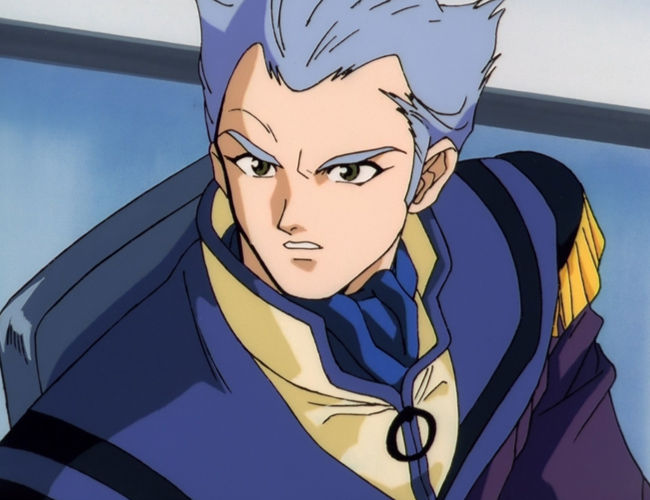
Gamlin is supposed to be around 19 years old but his pointed hair and voice make him seem older. There is nothing outright wrong with the look or the performance, he just comes across as way older than he is supposed to be. Granted, he is supposed to be mature and not a jerk like Basara.
A big problem is that Mylene’s stage costume is in effect a one-piece swimsuit. Although the tone is along the lines of “cool” rather than “sexy”, even for anime, it’s inappropriate (regardless of the age of the character). Like many things in this series, it’s just tacky and Mylene is a cool character, so she doesn’t need this. (Sadly, voice actress Sakurai Tomo passed away on 13 August 2025, aged 53, from multiple organ cancer.)
There are other silly elements. For example, Basara lives in the “unregistered” section of the city; it is in essence the slums with dilapidated buildings. It is drawn and rendered nicely. Obviously, it is meant to go with Basara’s image of a rebel but how can there be slums in a city ship? It’s not even that big.
This leads to a related point. The city, when viewed from within, always comes across as way bigger than it actually is and there is no need for that. Another issue is that the characters playing their instruments never match the actual music. This may be common in anime but a little effort in making it just a little realistic is not too much to ask.
The sound design and sound editing are not bad, although the jet sounds can use more variation. The voice acting is solid and consistent. In a way, the performances are what bring the series back from the brink of being intolerable.
The music, as already mentioned, is basically poppy arena rock with mildly glam rock/power metal vocals. If one doesn’t like those genres, then it is just cheese. For too many episodes, it’s just the same song.
In fact, the series has no score; it is merely Fire Bomber’s songs, a few other random songs, and segments from the Macross Plus soundtrack. For a franchise in which music is central, this is arguably pathetic. This approach might work if there is more variety of songs even in the early episodes.
●
Macross 7 has one of the most annoying main characters ever. And this is not helped by the poor pacing, dated visuals and the same song being used over and over again. The ideas are mostly good but at 49 episodes, it simply drags. If nothing else, some of these ideas set up the premise for subsequent series.
Be sure to subscribe to our mailing list so you get each new Opinyun that comes out!


Comments