


Anime Review: Kabaneri of the Iron Fortress
English Title: Kabaneri of the Iron Fortress
Japanese Title: 甲鉄城のカバネリ
Director(s): Araki Tetsuro, Tanaka Hiroyuki & others
Screenwriter(s): Okouchi Ichiro & Seko Hiroshi
Studio: Wit Studio
Released: 2016
Series Runtime: 12 episodes, ~22m each.
Part 1 Film Runtime: 1h 47m
Part 2 Film Runtime: 1h 43m
Starring: Hatanaka Tasuku, Senbongi Sayaka, Uchida Maaya, Masuda Toshiki, Kaji Yuuki

Set in an industrialized world typical of the steampunk genre, the population lives in fortified cities referred to as “stations”. Connecting these is a railway network with heavily armored trains that move people and supplies. Society is organized and run by the shogunate with the bushi serving as enforcers and the military.
The reason for living in fortified cities is that the kabane, which are essentially zombies, have taken over. They can run, climb, bite and even fight to a degree. The bitten become zombies soon afterwards, sometimes almost immediately.
The cause is supposedly a virus that appeared suddenly 20 years ago, although its origins are not explained. Sounds familiar. The kabane also have hardened heart cages, so killing them with swords or projectile weapons is difficult.
In the opening episode, a train taken over by the kabane conveniently crashes through the gate of Aragane Station governed by the Yomogawa family. Despite the existence of horns, the drawbridge in this case was lowered without any communication, and despite the existence of explosives, the bridge is not wired for these situations—as if these protocols are not in place in such a world. The story could still have this opening with these elements accounted for.

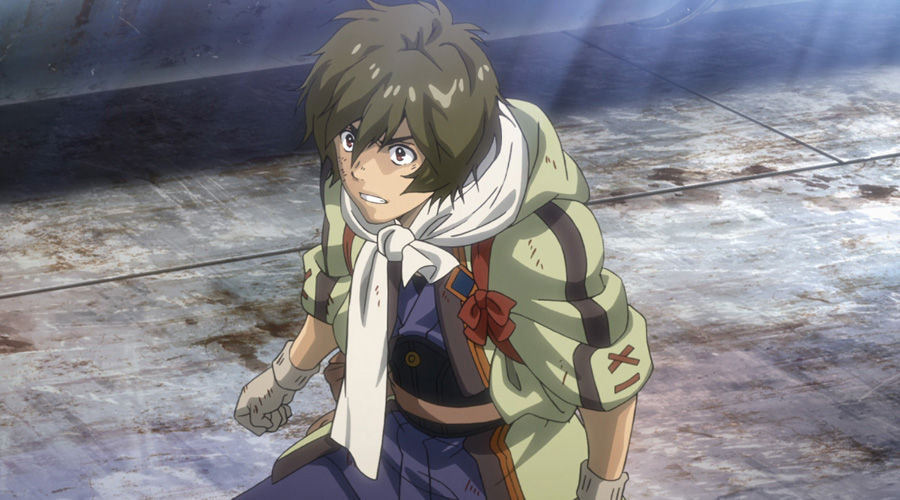
Accepting those aspects of the premise, the main character is a young man named Ikoma who is a steamsmith at Aragane. In the mayhem, he is bitten and he strangles himself to prevent the virus taking over his brain, thus becoming the overused “hybrid” with enhanced physical abilities. Somehow, he still needs the neck collar that is not tight enough to be uncomfortable. Also, as a steamsmith, he successfully made a higher-powered gun, so he is the “hero with a big gun” trope.
As survivors board the train Kotetsujo and evacuate Aragane, a seemingly nonchalant girl named Mumei displays exceptional combat skills and physical abilities. This obviously begs the question of what she is but no one dares to ask given her association with the shogunate. This is revealed soon as part of the plot.

Meanwhile, Ikoma is the stereotypical stubborn hero who is very vocal about injustices. He is not wrong, but he can still be annoying in his insistence. Either way, it is satisfying to see Mumei put him in his place.
The pathos is better written when he has to prove himself to skeptical humans that he is not a zombie even if the theme of class struggle has been literally done to death. This would be better if the narrative didn’t rely on skeptical humans being so stubbornly biased that a person who acts like a person in stark contrast to the undead is still assumed to be the latter. The point, as Ikoma points out, is that they are blinded by their fears but this is pushing too far for the sake of drama.
Ayame, the daughter of Yomogawa, assumes command of the surviving population on the Kotetsujo and they aim to go to Kongokaku, the shogun stronghold. As the plot progresses, they stop along the way for supplies and repairs. So, whilst there is clearly some inspiration from Snowpiercer (2013) or its source material Le Transperceneige (1982), this story thankfully avoids suffocating the audience by setting it exclusively on the train.
Despite the abovementioned conveniences, that two of the main characters are template superpowered, and that none of the elements are particularly original, the worldbuilding is still generally excellent. Details are revealed visually and/or through the drama, and the combination of said elements still makes a compelling world.

The pacing and the balance of drama and action are measured. Action scenes and set pieces are at appropriate intervals so they are not cheaply utilized. As already mentioned, the story is not stuck on the train so there is always some movement in one way or another.
The main weakness with the plotting is that it relies on more conveniences. There is the mandatory mutiny on Kotetsujo, which is fine in itself, but Ayame relinquishes command too easily. Also, some kabane have exceptional abilities but these are whipped out because the plot needs something bigger for the sake of drama.
Later, the plot brings in Mumei’s master who obviously has ulterior motives. This is fine in itself but the plot fails to take advantage of the opportunity to delve into the politics and actually have some intrigue. It looks like it’s going to for a moment but then doesn’t. Either way, even if his motives are understandable, his methods are so disproportionate that it is just petty.

Visually, it is beautifully designed and rendered. Details are almost never lacking, whether it is the environment or trains, with plenty of pipework, gauges and moving parts. The two standout issues are that the train driver lacks some sort of viewport and Ikoma’s gun is shown to be a piercing gun but references to bullets are made without clarification. The rendering is sometimes a little too specular but the tone is consistent and fitting to the genre.
The characters are designed nicely enough even if they are written too simply. Mumei is arguably too much of the “cute warrior chick” and Ikoma has the long hair covering one eye like an emo, which is just unnecessary. Nevertheless, the characters are generally well-drawn. There is common use of tight one-shots of faces with more refined shading reminiscent of the style seen in the 1980s and early 1990s. Although not jarring and the extra effort is appreciated, it is apparent.
The soundtrack by Sawano Hiroyuki is masterful as expected with his usual striking blend of orchestral themes with rock-pop. There is good variation; for example, the ending theme “Ninelie” by Aimer and chelly (from EGOIST) is more spaced-out to fit the darker and melancholic tone of the work. In some scenes, the score can have a stronger presence, being a little too low in the mix.
On balance, the premise is interesting enough with good worldbuilding. The series is solidly produced with good performances, great visuals and an awesome score.
As for the main characters, whilst there are background expositions and some character development, they generally lack a defining moment, like a key decision that wows the viewer. It is definitely a plot-driven rather than a character-driven work.
The plot is somewhat predictable, which is not a big issue in itself but for the excessive number of conveniences which are easily avoidable. Whilst the series ends properly, it still lacks an epilogue or denouement; the second compilation film merely adds a little to this.
There are two compilation films. Given the series structure, Part 1: Gathering Light (総集編{前編}集う光) covers the first half of the series and Part 2: Burning Life (総集編{後編}燃える) covers the latter half.
As one can see from the runtimes, the compilation films omit little from the episodes and what is omitted does make the series fuller. Some compilation films restructure and rearrange with additional material, and therefore actually attempt a retelling appropriate to a feature-length format. These two films do not do that other than a few minor changes and as such are pointless. There is, however, a sequel film set six months later.
Be sure to subscribe to our mailing list so you get each new Opinyun that comes out!


Comments