


Anime Review: Frieren: Beyond Journey’s End (Season 1 & 2)
English Title: Frieren: Beyond Journey’s End
Japanese Title: 葬送のフリーレン [lit. Funeral attendance of Frieren]
Director(s): Kitagawa Tomoya & others
Screenwriter(s): Suzuki Tomohiro
Studio: Madhouse
Released: 2023, 2026
Season 1 Runtime: 28 episodes, ~24m each.
Season 2 Runtime: 10 episodes, ~24m each.
Starring: Tanezaki Atsumi, Ichinose Kana, Kobayashi Chiaki, Okamoto Nobuhiko, Touchi Hiroki, Ueda Youji
Premise and Setting
This anime is based on the ongoing manga of the same name written by Yamada Kanehito and illustrated by Abe Tsukasa. I have not read the manga so this review is of the anime only.
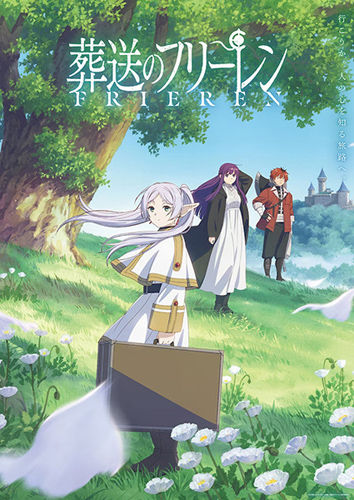
The story begins with the titular character Frieren, a young-looking female elf mage, returning from a ten-year quest with her party: Himmel the Hero, a human; Heiter, a human priest; and Eisen, a dwarf warrior. They had defeated the Demon King and in many respects saved the world.
The first two episodes quickly go through the decades immediately after, during which Himmel dies of old age. Frieren later stays a few years with Heiter who has adopted a war orphan girl named Fern.
As is common to the genre, the world is mostly medieval in aesthetics and technology and elves live much longer than humans. Frieren is at least one thousand years old. Not surprisingly, Heiter asks Frieren to take Fern as her apprentice after his death. When Frieren and Fern begin their travels, it is 26 years after the death of Himmel and the plot follows their adventure.
It is a challenging premise. Stories typically do not start at the end of a significant journey (including true death) involving the main character unless the narrative is basically one big flashback. The reason is simple: there is nowhere to go after the end.
As the English title suggests, this is not one big flashback but actually moves on, so it is intriguing just for trying. The first episodes are arguably a little clumsy because it jumps years, but it is not outright jarring and still sets up the characters effectively.
As Frieren and Fern travel, they get Stark to join them. He is a young man (human) and Eisen’s student, so he is the warrior of the party. They wander a bit and the plotting can feel that way.
Soon enough, Frieren decides to travel north as a sort of final goodbye to Himmel. This journey will be similar to the journey she took to defeat the Demon King. Despite having an objective and literally a direction, the plot can feel like it wanders a bit. However, the work still manages to settle into what it presumably is meant to be: a theme-driven work.

Themes and Characters
The party encounter problems and obstacles as expected given the fantasy-adventure genre—the Demon King may be gone but not every demon has been taken out and there are still the usual monsters such as dragons. Episodes are generally split into halves. Some problems are solved within one episode, others form a longer arc spanning a few episodes.
Thematically, these problems and obstacles are used to reveal the impact Frieren’s ten-year quest has had on her, sometimes without her realizing it until that point. After all, she can live for thousands of years, so ten years for her is not the same as for humans.
There is consistent use of brief flashbacks but these are tastefully short, not chunky telling of the past. They can come across as a little convenient at times but their journey was ten years long, so there is bound to be a memory for just about every occasion.
Does the work promote nostalgia? If one defines “nostalgia” as an excessive or inappropriate attachment to the past, then it mostly does not so far. Frieren, as the German word suggests, is the cool type and does not come across as nostalgic. And as an elf who barely ages (compared to humans and even dwarves), it’s as if she is frozen in time; she does not hang onto the past, that’s just her nature.
More importantly, from the audience’s point of view, the ten-year quest is not told so there is little to be nostalgic about. Instead, the work aims to be more reflective, although there is always the danger of crossing into nostalgia when reflecting on the past. Interestingly, time is always referenced to years after the death of Himmel.
The themes are apparent and any in-depth analysis requires an essay, so I will merely mention them briefly. Death and grief are the first to come to mind as Frieren deals with her regret of not knowing or understanding her friends as well as she should. Frieren plays it cool but she does have feelings, and taking Fern and Stark under her wing is a way of making up for it.
As they travel, there is no shortage of statues of Himmel and people who have heard the story. The former is a bit of a running joke. Either way, tradition is evidently alive and healthy and this is distinct from nostalgia.
Tradition is the content and the means by which said content is preserved and transmitted, and it is clear that people are not dwelling on the past but rather keeping something important alive.
This would perhaps not be needed as much if elves are more sociable since, in this case, Frieren was a participant and witness and she is still alive. That quest is literally in living memory and she could directly pass on that knowledge by oral tradition and/or in writing. But that is a sidebar.
Related to death is the afterlife and this is one weak point of the work. Like many modern works, it takes a somewhat humanistic and materialistic view to avoid being offensive.
Frieren is skeptical of Heaven because there is no way to observe it and therefore no way to prove or disprove it. If one takes that modern scientific approach, then that is strictly speaking true. Heiter, despite being a priest, takes the emotional view: one believes in Heaven because it is “convenient”.
One should believe in something because there is sufficient reason to believe that it is objectively true rather than out of convenience. Of course, the above sentiment is understandable and should not be dismissed but the story unfortunately does not explore that so far; for example, why do people feel that way?
That being the case, Heiter does appeal to justice. People believe in Heaven because they need to believe their good works in life mean something, that it could all lead to something more after death. Unfortunately, this line of reasoning is not taken farther even though the character of Himmel (the German word for “Heaven”) subtly illustrates this. He was happy to help people during the ten-year journey—he is remembered as a hero and Frieren definitely learnt from his example, serving as a clue that this approach to life can lead oneself and perhaps others to Heaven afterwards.
The other angle to explore Heaven is to explore Hell which so far it has not done, at least not explicitly, other than the existence of “demons”. In fiction, the term can be vague so it is unclear what they are exactly in this work.
Some are overtly “evil monsters” but some are ambiguous, which is presumably intentional. The latter are cunning as they talk and negotiate, to seem reasonable and civil. Whilst most characters and the audience are unsure of what they are and how to deal with them appropriately, Frieren is one of the few who takes a seemingly simple and harsh approach: she doesn’t listen to them, she just takes them out. Either way, this depiction of the demonic nature is as intriguing as it is disturbing.
Characters
Apart from their thematic significance, the writer has also made sure the characters have their quirks. This is more of a necessity in a work that leans towards being theme- and character-driven rather than plot-driven. This also makes characters more memorable and possibly more lovable.
For example, Frieren sleeps in late and does not spend her money wisely despite being by far the oldest character. She is in many ways the most knowledgeable and mature but she does have trouble dealing with other people, having a childlike (innocent) ignorance.
Fern is the one who keeps things in check. Perhaps her name, meaning “far-away” or “distant” in German, is an indication. Despite being far from Frieren in age and background, she is the one who connects Frieren to the present and to others.
Stark, meaning “strong” in German, is the warrior of the party who carries an ax. He has issues of perceived cowardice from the past but Fern and Frieren bring him out of it. It is a typical setup but he does bring some balance to the group. Being the only dude, he is very patient putting up with two women; whilst Frieren is cool, Fern is definitely human and prone to give the silent treatment when she is upset.

One point worth mentioning is that the writer does not try to play down Frieren’s abilities as a mage given her natural talent and extensive experience. There are situations in which magic does not work but the writer does not concoct some convenient excuse for it. The rules are fairly consistent: one either has the spell or not; power is a variable, so it is possible to have little effect; and others can detect, dodge or withstand attacks, so physical prowess is still a factor.
It is mildly comical and a bit of a running joke that Frieren is OP in many cases. There is typically the problem of how to apply magic but she generally has little trouble. There is the common use of a hard cut to a wide shot followed by a massive explosion that takes out a good patch of forest. Fern, given her natural talent and being Frieren’s apprentice, is also OP.
Their combat tactics tie back to the theme of tradition: no point doing newer fancy stuff if it is ineffective, just stick to fundamentals and make sure to do it well.
It is good to see Fern getting taller as time passes, as well as her growing attachment to Frieren, even to the point of being jealous and protective of her teacher. With both Fern and Stark being physically bigger than Frieren, it helps convey her as childlike.
Production and Concluding Comments

The production is solid. Visually, it avoids “dark and gritty”. It is more like a picture book with paint daub effects in the environment. This thankfully does not mean details are sacrificed. There is sufficient detail in most shots.
The characters have sharp linework and are nicely rendered. Although they look simple, they avoid looking too simple and therefore cheap.
The action sequences are generally well done with the occasional longer tracking shots that follow the action. There needs to be more of these shots.
The score composed by Evan Call is fitting to the genre with the common use of what sounds like the lyre or lute, in essence medival tavern music. The performances are solid across the board, they just fit the character and the situation. Frieren may be the typical “cool chick” but that’s what she needs to be.
Overall, it is not as if Frieren is the best thing ever—it remains to be seen whether that may be the case—but it is certainly intriguing and refreshing. It has a premise that is challenging for any writer, it has worthy themes, and it has some depth and emotional resonance without trying too hard.
Be sure to subscribe to our mailing list so you get each new Opinyun that comes out!


Comments