


On Church Authority – Part I
This article aims to defend ecclesiastical (church) authority. This is not an apology for whoever is currently at Rome as that is another topic in itself, but rather for authority conceptually, including the papacy. As usual, the matter is not that complicated. It is made complicated by over-simplifications and ambiguity, deliberately or otherwise.
This is a three-part series, moving from the general to the specific. Part I is a brief overview of authority in the Old Testament. Part II and Part III will examine some specifics of the New Testament.
Although this can be done in one long article, even a brief coverage of the supporting material demands multiple shorter parts.
1.1 Definitions
It is necessary to provide a definition or a description, else the discussion will go in circles. The defintions below are reproduced from A Dictionary of Scholastic Philosophy (2nd ed.) by Bernard Wuellner SJ.
authority n: 1. the moral power to command or enforce obedience in a community.
A power can be defined as “capacity for acting” or the “ability to effect change”, and it can be, for example, physical or intellectual. A moral power in philosophical terms can be called a “right”.
right n: 2. objective right. the just thing; the due good; the object over which a person has an inviolable moral power. 3. broadly. justice; moral goodness; legally allowed conduct; equity.
On a related note, both authority and their subordinates have their respective duties.
duty n: 3. specifically. acts or omissions to which one is morally bound by justice or one of the potential virtues of justice: as, duties to one’s office, family, parents, etc.
In other words, human authority of any type is bounded by morality and is therefore conditional. To use a crude illustration: armed cops and robbers in a shootout both have power but only the former has authority.
1.2 Adam and the Patriarchs
Some state that all authority comes from God as if to imply there is no human authority. Whilst it is true that God has ultimate authority, the implication that it cannot be conferred, directly or indirectly, is false.
As written in Genesis 1, God created man in his own image and, amongst other things, said the below to indicate general authority that man has over the rest of creation:
Increase and multiply, and fill the earth, and subdue it, and rule over the fishes of the sea, and the fowls of the air, and all living creatures that move upon the earth.
Genesis provides a genealogy starting from Adam. Although not explicitly stated, the fact that it provides a particular line suggests some sort of authority being passed on said line.
This is supported by Hebrews 7 which calls Abraham a “patriarch”, in this case implying a priestly (religious) authority. So, the word “patriarch” can be used for civil authority and/or religious authority.
Also, Cain and Abel made sacrifices to God (Genesis 4), which indicates priestly authority since the primary function of the priesthood is sacrifice.
Later, God reveals that Abraham is a “prophet” in Genesis 20:7. The word has multiple meanings but literally is based on “to speak”. Thus, a prophet functions as an interpreter and voice for God and in this manner has religious authority but is distinct from a priest. So, Abraham had civil authority and religious authority (as priest and prophet).
1.3 Moses & Aaron

Moses was a prophet “whom the Lord knew face to face”. (Deuteronomy 34:10) He led the people out of Egypt, was a lawgiver and acted as judge to resolve issues. Thus, he had religious and civil authority.
It also got to the point that Moses had to delegate judicial authority due to heavy workload. (Exodus 18) This is a prototype of civil authority today with delegated authority and hierarchy: executive, legislative and judicial, and it is clear Moses remained the chief in all three branches.
His brother, Aaron (the Levite), and his descendants were chosen as priests and thus had religious authority. Aaron was specifically the Levitical High Priest. (Exodus 28)
So, at this point, the distinctions become clearer. There is civil authority and religious authority. And within religious authority, there is a distinction between the priest and the prophet.
At the passing of Moses, his authority passed to Joshua (Joshua 1) and Caleb (Judges 1) whilst the Levites continued to hold the priesthood, also referred to as the “levitical priesthood”.
1.4 Judges
Soon after the death of Joshua and Caleb were leaders of the Israelites referred to as “judges”. The book of Judges records 12 such leaders and their activities. This period spanned approximately 300 years. (The story of Ruth occurred during this period.)
God elected the judges directly, starting with Othoniel. (Judges 3) As the word implies, they had civil authority. This is also apparent given their military campaigns against surrounding pagan kingdoms. Deborah, the fourth judge, was also a prophetess so in at least one case, a judge also had religious authority. (Judges 4)
Meanwhile, the priesthood continued to be held by the Levites.
1.5 Kings
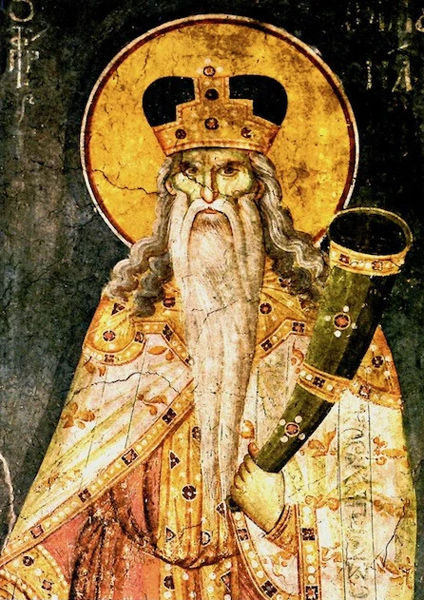
Elcana was of the tribe of Levi and a priest. He had two wives, Phenenna and Anna. Anna was barren and desperately prayed for a child, and God eventually gave her a son which she named Samuel. As promised, she handed him over in service to God under the priest Heli.
As a child, God called Samuel who later became a prophet and judge (1 Samuel 1–3). Thus, Samuel had religious and civil authority. He was the thirteenth and what was to be the last judge.
The Israelites demanded a king and God reluctantly agreed, warning them what a king would do to the people, such as going to war, taxation, amongst other things. (1 Samuel 8)
Under direct instruction from God, Samuel anointed Saul, their first king in ~1100 BC. The king had civil authority only. God continued to elect prophets whilst the priesthood was held by the Levites. God often used the prophets to tell kings to behave because many did not.
1.6 Maccabees
The two books of Maccabees cover the political mayhem of the Hebrew people and in relation to others such as the Greeks, Syrians and Romans. This period spanned approximately the 200 years before the birth of Christ.
The Maccabees, starting with Mathathias, were priests and led the Israelites in battle against her enemies. In short, they held both religious and civil authority.
1.7 General Observations
● Authority is given or conferred downwards; that is, from God to man, and one man to another.
● There is a distinction between religious authority and civil authority, without implying that a given individual cannot have both.
● Regarding religious authority, there is a distinction between the priest and prophet.
● The worship of and sacrifice to God was handled by those set apart with priestly authority, with one high priest amongst them.
● Priests are also meant to possess knowledge and teach. From Malachi 2: “For the lips of the priest shall keep knowledge, and they shall seek the law at his mouth: because he is the angel of the Lord of hosts.”
● God commands due honor to authority, starting with one’s parents as told to Moses in the 4th Commandment. “Honour thy father and thy mother…” (Exodus 20, Deuteronomy 5) Note that in the Ten Commandments, the first three relate to God and the next seven relate to other people, and human authority is the first of the latter group.
● It is generally taught that “fathers” refer to those in authority, including civil authority. For example, Naaman’s servants addressed him as “Father”. (2 Kings 5)
● Ecclesiastes 12 reminds one to obey God’s commandments (which includes human authority): “Fear God, and keep his commandments…” The duties towards those in authority are elaborated in Ecclesiasticus 3: “For God hath made the father honourable to the children: and seeking the judgment of the mothers, hath confirmed it upon the children.”
● Ecclesiasticus 7 also elaborates on religious duties: “Honour thy father, and forget not the groanings of thy mother: Remember that thou hadst not been born but through them: and make a return to them as they have done for thee. … With all thy soul fear the Lord, and reverence his priests.”
● Just as the Fourth Commandment promised (the possibility of) a long life as a reward, the opposite can be a possible punishment to those who do not: “But he that will be proud, and refuse to obey the commandment of the priest, who ministereth at that time to the Lord thy God, and the decree of the judge, that man shall die, and thou shalt take away the evil from Israel.” (Deuteronomy 17)
● Given God’s explicit comments in 1 Samuel 8–12, He prefers a form of theocracy in which He directs prophets and priests who then direct the masses.
● Despite the above, God permitted the Israelites to have a king. The king was anointed by a prophet and expected to behave accordingly. Thus, there is separation of religious authority (church) and civil authority (state) in operation but the latter is still morally subject to the former—“separation of Church and State” should only mean the former and not the latter.
● Regardless of the exact system of government, God seems to prefer a monarchial system; that is, one person at the head. This more faithfully reflects the image of one Creator at the top with creatures below.
●
Click here for Part II.
Be sure to subscribe to our mailing list so you get each new Opinyun that comes out!


Comments