


Study: Sharks Need Buddies Too
A study by N.D. Marosi et al titled “Rolling in the deep: drivers of social preferences and social interactions within a bull shark aggregation in Fiji” posted on 17 March 2026 shows that bull sharks, Carcharhinus leucas, are perhaps more socially complex than the “lone shark” image. The paper is about 16 pages and is an interesting read.
The observations were made at the Shark Reef Marine Reserve (SRMR) in Fiji from 2018 to 2023. Dives were made five times per week at three different depths for as long as 28 minutes.
A total of 221 individual sharks were identified. Most were identified by unique physical features such as scars but 50 were required to be tagged. Only 184 individuals were recorded during dives (151 female, 33 male). When individuals could not be identified due to a lack of visibility, they were not recorded.
Individuals were classified as “Subadults”, “Adults” or “Advanced Adults” depending on their size even though “age only partially correlates with size”, physical evidence of mating and presence or absence during the parturition seasons. There is overlap between the categories. For these sharks, girls are bigger than boys.
Of the total 473 dives (8192 minutes), due to visibility limitations, only a total of 385 dives (6658 minutes) were used in the analysis. Sociability was quantified using behaviours such as “lead–follow” or “parallel swim”.
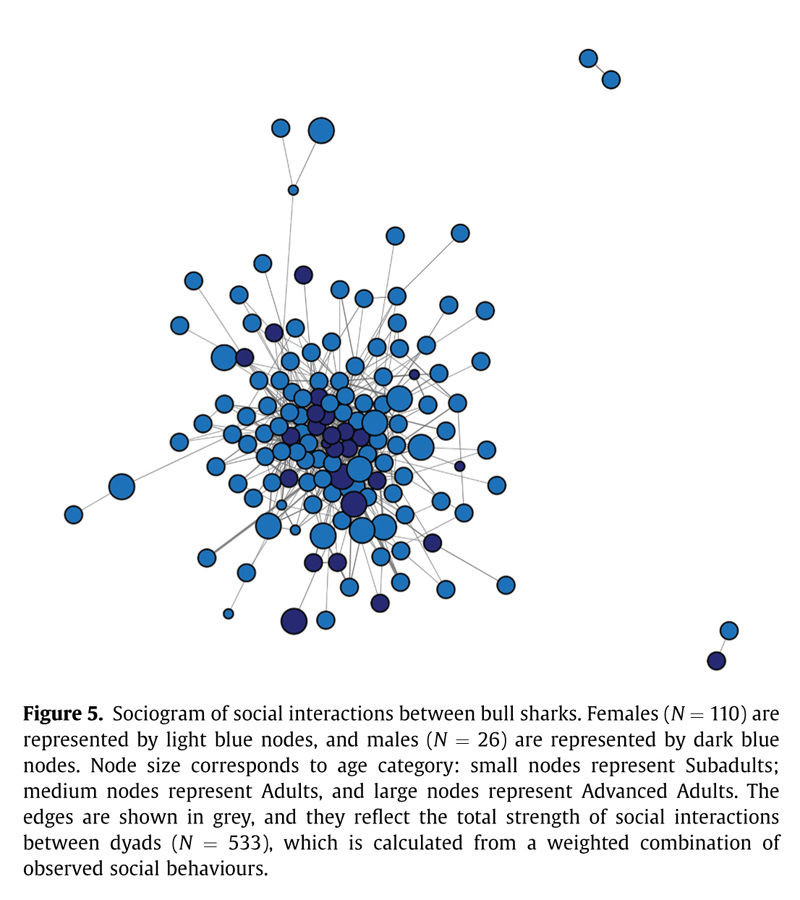
In total, the data comprised 1438 association observations for 152 sharks and 1719 social interaction observations for 136 sharks identified.
Although such an environment might promote social interactions, some of the observations are nonetheless interesting. A few points are mentioned below.
Most of the associations are female–female.
Mixed-sex associations are common, with males preferring females rather than other males.
Although most of the sample population is female, “male bull sharks have higher centrality metrics than their female counterparts, and these metrics were significant, indicating that males hold more central positions in the network, with more associates, whereas both sexes displayed similar association frequencies.”
Adults tend to associate with other adults.
Subadults do not associate with their own age class or Advanced Adults, but there is a “slight tendency” to associate with Adults.
Advanced Adults also do not associate with their own age class or Subadults, but there is a “slight tendency” to associate with Adults.
Overall, Advanced Adults are less socially connected than the other two age classes.
Generally, size does not seem to play a role in associations.
Higher interactions were observed, indicating stronger or “preferred” associations (when some avoid each other).
The data does not indicate why the sharks behave as they do, although the authors do speculate in the discussion, ranging from proximity to mating zones to individual needs and personalities.
The paper does not provide data at the individual level. It would be interesting to see if a given pair or group had developed over the course of the six-year study period. Nonetheless, what is presented somewhat resembles people, which is not that surprising.
Be sure to subscribe to our mailing list so you get each new Opinyun that comes out!


Comments