


Study: Korean Fermented Foods Associated with Reduced Inflammation
A study by W. Na and C. Sohn titled “The Association Between Fermented Food Intake and Hs-CRP Across Age Groups in Korean Adults: Effect Modification by Sodium Intake” published on 16 April 2026 finds that Korean fermented foods are associated with reduced inflammation but not necessarily for older people.
The paper is 13 pages long with the main text at about 10 pages, the remaining is references.
High-sensitivity C-reactive protein (hs-CRP) serves as a widely adopted marker of systemic inflammation, with demonstrated prognostic value for cardiovascular events and all-cause mortality across a broad range of concentrations. Identifying dietary factors associated with hs-CRP levels, therefore, carries direct relevance for chronic disease prevention strategies.
The study used data from a survey provided by the Korea Disease Control and Prevention Agency (KDCA). There were 31,649 participants in the survey, of which those who eat very little, amongst others, are excluded, leaving 17,984 individuals.
The study sample contains more women than men, at approximately 56% and 44 % respectively. Individuals are divided into three age groups: 20–39 years, 40–64 years and ≥65 years.
The study examines how salt intake impacts the benefits of fermented foods since Korean fermented foods have comparatively higher sodium levels. For this study, fermented foods are classified into ten groups; for example, the jang group includes soy sauce and doenjang, whilst the vegetable group includes kimchi.
As expected, the youngest age group has a higher overall calorific intake and sodium intake than the oldest age group. Across all three age groups, grains, jang and vegetables make up the bulk of the energy and sodium intake amongst fermented foods.
In short, the younger age groups seem to benefit from the fermented foods with a lower hs-CRP.
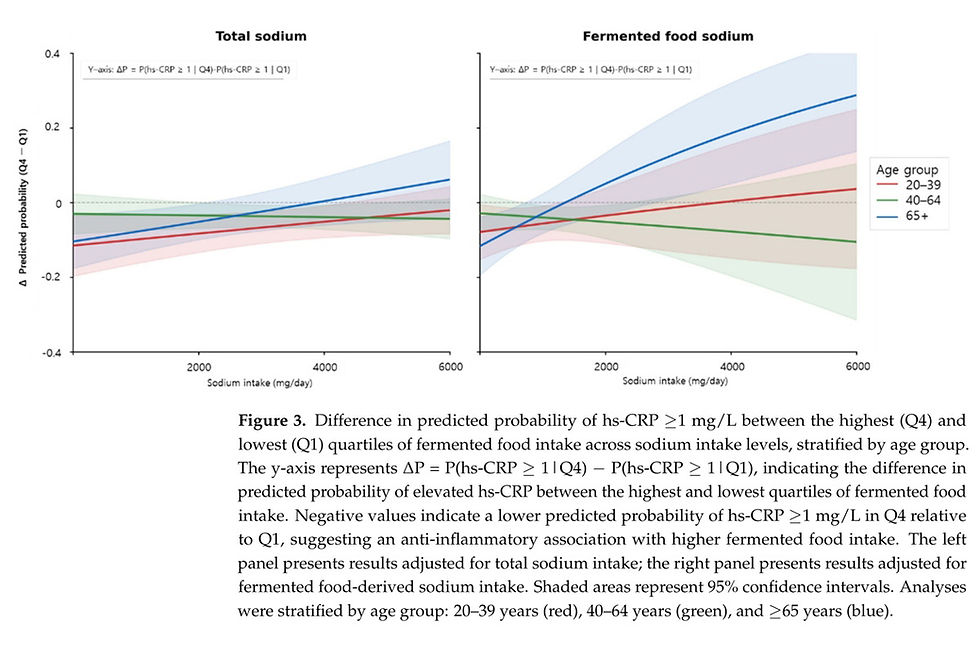
In this study, the association between fermented food intake and the risk of hs-CRP ≥1 mg/L differed across age groups. Among adults aged 20–39 and 40–64 years, higher fermented food intake was consistently associated with lower odds of elevated hs-CRP. This inverse relationship remained after adjustment for sodium intake, suggesting that the observed association is not solely explained by sodium.
However, this is not observed for the older age group of ≥65 years.
Further analyses showed that the inverse association between fermented food intake and hs-CRP was more evident at lower sodium intake levels and became attenuated as sodium intake increased. This pattern was not observed in the younger age groups. These findings are consistent with previous research suggesting that sensitivity to sodium increases with age, possibly due to reduced renal function, changes in vascular responsiveness, and alterations in immune regulation. Such age-related differences may help explain why sodium plays a more prominent role in shaping the relationship between fermented food intake and inflammation in older adults.
The study is highly generalized as it does not take into account the great variations of Korean fermented foods. After all, one batch of kimchi can be very different from another batch. It is not merely the sodium levels but also the levels of everything else, such as acids and microbial metabolites which impact the immune system. The study is also limited in that it does not examine the effects of long-term/habitual consumption.
Despite all that, it seems that Korean fermented foods are generally good for you, but it does depend on the specific type, their composition and quality. Older people still need to be careful with their sodium intake.
Be sure to subscribe to our mailing list so you get each new Opinyun that comes out!


Comments